




Supremum
Suppose  is bounded above. A number
  is the supremum of if is an upper bound of and any number less the is not an upper bound of . We write = sup
is bounded above. A number is the supremum of if is an upper bound of and any number less the is not an upper bound of . We write = sup Infimum
Suppose is bounded below. A number  is the infimum of if is a lower bound of and any number greater the is not a lower bound of . We write = inf
is bounded below. A number is the infimum of if is a lower bound of and any number greater the is not a lower bound of . We write = inf Converges to a number L
A sequence { } converges to a number
  if
if
 Z
Z  . The number
  is called the limit of the sequence and the notation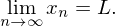
} converges to a number if Z . The number is called the limit of the sequence and the notation Bounded Below
The set is bounded below if there is a number  such that
  . The number is called a lower bound of .
is bounded below if there is a number such that . The number is called a lower bound of .Bounded Above
The set is bounded above if there is a number  such that
  . The number is called an upper bound of .
is bounded above if there is a number such that . The number is called an upper bound of .Bounded
The set is bounded if there is a number such that  . The number is called a bound for .
is bounded if there is a number such that . The number is called a bound for . such that
 and
and 


Interval
A set of real numbers is an interval iff contains at least 2 points and for any two points  , every real number between
  and
and  belong to as well.
of real numbers is an interval iff contains at least 2 points and for any two points , every real number between and belong to as well.Finite
A set  is finite if it is empty or if its elements can be put in a one to one correspondence with the set {1,2,...,n} for some n.
is finite if it is empty or if its elements can be put in a one to one correspondence with the set {1,2,...,n} for some n.Countably Infinite
The set is countably infinite if its elements can be put in a one to one correspondence with the set of positive integers
is countably infinite if its elements can be put in a one to one correspondence with the set of positive integers
Subsequence
Let  be a squence and let
  be a strictly increasing sequence of positive integers.
The sequence is called a subsequence of
be a squence and let be a strictly increasing sequence of positive integers.The sequence
is called a subsequence of 
Order
<, on a set is a relation with the following properties;
Trichotomy, if , then only 1 of the following holds;
  or
or 
Transitivity, , if
, if  and
and 
is a relation with the following properties;Trichotomy, if
, then only 1 of the following holds; or Transitivity,
, if and Field
A non empty set,  , with
  , with 2 operations, + and * w the following properties;
, with , with 2 operations, + and * w the following properties;| Closure |  |  |
| Commutative |  |  |
| Associative |  |  |
| Identity |  |  |
| Inverse |  |  |
| Distributive |  |
 that is bounded above has a supremum
 is an interval if it has the properties that if
  , and
, and  , then if


 , and
, and 


Squeeze Theorem for Functions
Let I be an open interval containing point c and suppose  are functions defined on I except pssibly at c.
Suppose \{c}
\{c}
if then f has limit at c and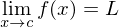
are functions defined on I except pssibly at c.Suppose
\{c}if
then f has limit at c and Subsequential Limit
The Subsequential limit of is any real number, x, such that there exists a subsequence of that converges to x
is any real number, x, such that there exists a subsequence of that converges to xDifferentiable at c
Let  be an interval, let
  , and let
  . The function
  is differentiable at c provided that the limit
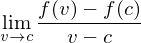
exists. The derivative of at c is the value of the limit and noted by 
be an interval, let , and let . The function is differentiable at c provided that the limitexists. The derivative of
at c is the value of the limit and noted by  is continuous on
 c,d
c,d 
Uniformly continuous
Let be an interval. A function  is uniformly continuous on if
  that satisfy
  .
.
be an interval. A function is uniformly continuous on if that satisfy .
Chain Rule
Let be an interval,  ,
,
is defined on  that contains
if is differentiable on , and is differentiable on then
  is differentiable on and
be an interval, , is defined on that contains if
is differentiable on , and is differentiable on then is differentiable on andIntermediate Value Property
A function defined on an interval has the intermediate value property on if it satisfies the following condition: if  and
and  are distinct points in and
  is any number between
  and
and  , then there exists a point
  between and such that
defined on an interval has the intermediate value property on if it satisfies the following condition: if and are distinct points in and is any number between and , then there exists a point between and such that Limit Superior
if  is bounded above then the limit superior is defined by
if not bounded above then the limit superior=
is bounded above then the limit superior is defined by if not bounded above then the limit superior=
Limit Inferior
if is bounded below then the limit inferior is defined by 
if not bounded below then the limit inferior = -
is bounded below then the limit inferior is defined by if not bounded below then the limit inferior = -
Right Hand Limit
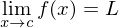
is an open interval containing or is at endpoint. is a function defined on except maybe at if
 or if is left endpoint, then has right hand limit L at c if
Left Hand Limit
is an open interval containing or is at endpoint. is a function defined on except maybe at if
or if is right endpoint, then has left hand limit L at c if 
 at c
at c that satisfy
 {
{
Jump Discontinuity
has jump discontinuity at if the one sided limits exist but are not equal .
. 

Removable Discontinuity
at c if  exists, but
  is either not defined or has a different value from the limit as x approaches c
exists, but is either not defined or has a different value from the limit as x approaches cTagged Partition
A tagged partition  of an interval
  consists of a partition
 {
{  } of along with the set
{ } of points, known as tags, that satisfy
  for
for  .
.
We will express a tagged partition of by
 {
{  }
}
of an interval consists of a partition { } of along with the set{
} of points, known as tags, that satisfy for .We will express a tagged partition
of by { }Norm of Partition, ||P||
The Norm of the partition P, ||P|| = max
If and
and  are partitions of and
  is a refinement of
If
and are partitions of and is a refinement of Riemann Sum
Let  and let
  be a tagged partition of . The Riemann sum
  of associated with is defined by:
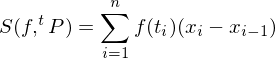
and let be a tagged partition of . The Riemann sum of associated with is defined by:
Riemann Integrable
A function  is Riemann integrable on if there exists a number with the following property: for each
 , such that
  , for all tagged partitions of
  that satisfy
is Riemann integrable on if there exists a number with the following property: for each , such that , for all tagged partitions of that satisfy Riemann integral
The number L is called the Riemann integral of on and is denoted by the symbol  , or simply
  .
.
on and is denoted by the symbol , or simply .
Kartensatzinfo:
Autor: Squiggleart
Oberthema: Mathematics
Thema: Advanced Calculus
Schule / Uni: West Chester University
Veröffentlicht: 25.05.2011
Schlagwörter Karten:
Alle Karten (51)
keine Schlagwörter
